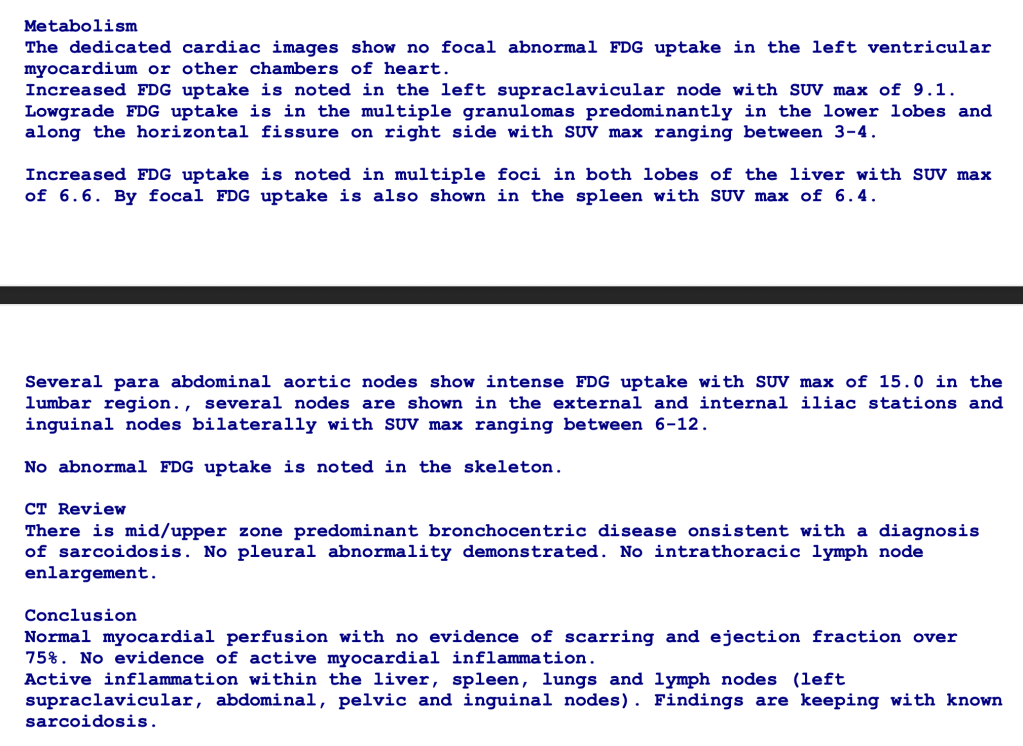
So what did all that mean?
- My heart looked strong and unaffected. However, the MRI didn’t 100% agree.
- Sarcoidosis is active elsewhere (lungs, lymph nodes, liver, spleen)
- The doctors reassured me that activity in the liver and spleen, while it sounded scary, is usually not something to panic over. These organs rarely develop serious issues, though it can happen in some cases. So for most people, it’s not nearly as concerning as problems in other organs.
- The real focus, as I understood it, was on my lungs and heart—trying to prevent fibrosis from developing in the future. Spoiler alert: that plan didn’t entirely go as hoped.
- Findings are consistent with sarcoidosis, not cancer.
- The PET Scan helps to shine a light on all inflammation in the body.
- SUV Max is basically the measure of how active something is on the PET Scan, the higher the uptake the higher the inflammation in this case.
Now for the MRI
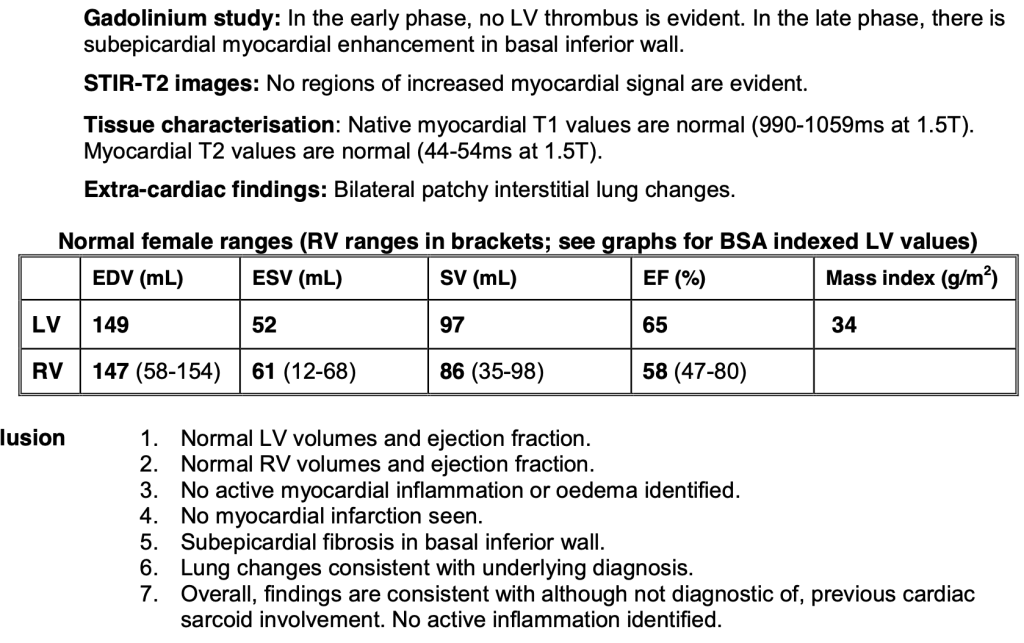
When the dust finally settled and all the results were pulled together, the picture became clearer. There was no active inflammation in my heart — a sentence I didn’t realise I’d been holding my breath for. There was, however, a small area of fibrosis in the heart wall. The doctor explained that this was likely scarring from a previous cardiac episode, not something currently active. Taken as a whole, the diagnosis landed as pulmonary sarcoidosis, with limited cardiac involvement. So what next? how can I prevent scaring and how can I reduce the inflammation?
What I’m sharing here — the screenshots, the numbers, the clinical bits that normally live quietly in hospital portals — is really about context. It’s about showing you where I started, so you can understand the road between then and now. Because progress, especially with chronic illness, rarely looks like a straight line.
Somewhere along the way, fibrosis decided to make a subtle guest appearance. A small amount showed up in my lung, and yes, there’s some in my heart too. My 2025 scans showed low inflammation, and that’s a win I’m holding onto tightly. Next MRI and Scan May 20206.
I’m focused on doing the things within my control. I’m exercising. I’m eating well. I’m actively choosing positivity — not the toxic, glittery kind, but the stubborn, keep-going-even-when-it’s-hard kind.
And don’t get me wrong… it is hard. This journey is very much up and down. Two weeks ago I got the flu, and the last fortnight has been rough. Trying to get back into work and exercise has felt like starting from scratch — the kind where you finish a gentle workout and feel like you’ve been hit by a London double-decker bus.
The honest truth? I prioritise exercise over other things. If I have to choose between a social plan and moving my body, I’ll usually pick exercise — even knowing I’ll be exhausted afterwards. Not because I’m disciplined or virtuous, but because I’ve learned the hard way what happens when I don’t. I need to stay strong. Physically, yes — but mentally too.
After my initial diagnosis, and the prednisone saga I’ll talk about later, I was unbelievably weak and in so much pain I genuinely felt about 90 years old. Everything hurt. Everything was hard. And that version of me is never far from my memory. I looked in the mirror and I didn’t see me any more. Now I am holding onto me, the me I expect to see in the mirror.
Today, I am not feeling great but “this to shall pass”
One last suggestion, try and get copies of your test results, sign up to your hospital portal if you can, if not ask for them. You need to be your biggest advocate, you need to do your own research. There have been times where if I hadn’t things could have been worse.
 CuriousBethLivingLife