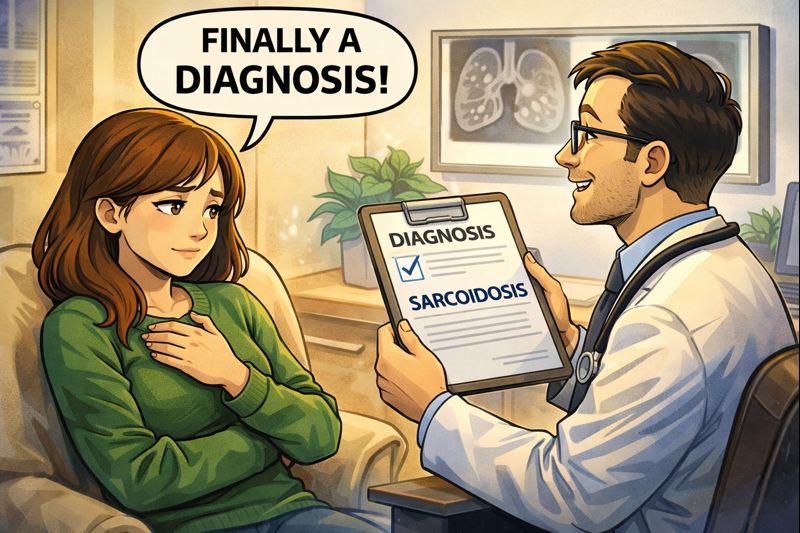
Tag: health

  • Hello fellow warriors

    Hello fellow warriors

    If you’re here, chances are you’re knee-deep in weird symptoms and vague answers.
    It’s like playing a never-ending game of “find the reason for the symptom?”

    You’re not alone.


    🛣️ Today, I want to take you on a little trip down memory lane…

    Not the fun kind with photo albums and cake, but the confusing, exhausting, and often-dismissed journey I went through before ever getting a diagnosis. There is another post, ‘the one where the mystery begins’ pre 2008. That brings you up to speed with the freight train that hit me before the next 14 years of often, silent suffering.

    Spoiler: the road was long. Buckle up.


    📅 2008–2021: Fatigue, Aches, and Fog

    Just a quick note here — I’d been experiencing fatigue since 2008, often following busy weeks or periods of stress.

    I’d pop some ibuprofen, and push on through ( POT). Having an 8 year old, looking after a home and working hard to get noticed at work is no mean feat even without the health concerns lurking at every corner of my mind.

    I was worried, what was wrong with me, was I going to have another 2007 episode.

    During this long chapter of my life, I continued to climb the career ladder, often pushing myself to stay in work even when I was unwell, sometimes battling infections. I didn’t complain. I kept it quiet, staying under the radar and just getting on with it.

    Infections became a regular part of life, as did long periods of exhaustion. I remember taking my daughter to Hampton Court Palace and feeling overwhelming gratitude when lunchtime arrived, simply because it meant I could lie down on the grass while she ate.

    I’d pop to Mum’s so I could stretch out on the sofa while she looked after my daughter, or feel unreasonably upset if anything disrupted my bedtime routine. But it wasn’t really about routine at all — it was about survival. I was carefully protecting every scrap of energy I had left.

    Let’s fast-forward to 2017 — the year everything really started to shift.


    ⚠️ 2017: Stress and Anxiety Take Hold as Chaos Unfolds…

    Some of you might remember the March 2017 terrorist attack on Westminster Bridge. Unfortunately, I was caught up in that — though, thankfully, not physically injured.

    I was in Parliament Square as it happened. In the moments before the police arrived, time seemed to slow down. It was eerily quiet as people tried to make sense of what was unfolding. I was in my car, driving toward the bridge — directly opposite the car that plowed into the students. At first, I thought it was an accident. But as I edged forward and saw people lying in the road, the reality hit: it was an attack.

    Then I heard gunshots behind me and thought we were under fire from multiple terrorists. I hadn’t seen any visible police presence yet, and no one knew what was going on. My brain kicked into survival mode. I ended up ducking under my steering wheel, convinced there were shooters.

    🚨 There weren’t, the gun shots behind me were the police dealing with the Terrorist.

    I eventually drove home in shock, hands trembling. I was so shaky I poured boiling tea over myself trying to calm down.


    The very next day, I got on the tube to head back to work. Someone shoved past me, and the woman behind me spilled her coffee and let out a yelp.

    💥 I completely melted down — shaking, heart racing — her yelp triggering a full-blown panic reaction.

    That was it for me and the tube.
    I didn’t ride it again for a year.
    I felt claustrophobic and panicked, like I couldn’t breathe.


    None of this, by the way, has anything to do with Sarcoidosis.
    But I was very stressed.

    Not long afterwards the Manchester bombing triggered an unexpected wave of anxiety. Watching the news, I felt irrationally overwhelmed, even though I wasn’t directly affected. I realise others faced much worse, but I’m being honest about how it stirred something in me.

    I didn’t want anyone to know I was struggling, so I went to the GP in secret. I explained I couldn’t cope with crowded spaces or public transport. I was incredibly anxious.

    Her response?

    “There’s no therapy I can offer for this”

    I wasn’t offered support. That GP (not the one I have now) clearly got into medicine for the paycheck, not the people. There was no bedside manner. There was no compassion. There was nothing.

    🙍‍♀️ For me, asking for help was hard. I didn’t know where else to turn.

    During this period life was stressful on and off at work and at home. Life felt hard whilst there was lot’s of good times in between I felt 💩 a lot in between.


    🦴 Joint Pain, Tiredness & Feeling Older Than I Should

    Around this time, I started to feel unwell. I had low-grade fevers and constant aches. My joints became increasingly painful, especially my knees.

    🚗 I was driving more to avoid public transport and wondered if my manual car was contributing.

    I used my company BUPA plan to see a private doctor.

    An MRI of my knees followed, leading to injections in both — which did absolutely nothing.

    Looking back, it was like trying to fix a fire alarm by painting over it.
    My body was screaming; I just wasn’t listening yet.

    Convinced my manual car was the culprit, I made a full-grown-up decision and bought an automatic.

    Surely, that would fix everything.
    (Spoiler: it didn’t.)

    This cycle continued for the next few years. I managed it with ibuprofen. To be fair, it did help at times.


    🩺 2019: Gynaecological Plot Twist

    Then came a hysteroscopy for some ongoing gynaecological issues. I woke up from what was meant to be a routine investigation to find they’d done extensive adhesiolysis — essentially, my insides were stuck together like a clingfilm disaster.

    Oh, and surprise! I also had adenomyosis.

    At this point, I started wondering:

    Could the fatigue, the joint pain, and the general body weirdness all be connected?

    Since being diagnosed with Sarcoidosis, I don’t believe they’re related anymore.
    But at the time, when symptoms are all over the place, it’s easy to feel lost trying to piece it all together. You become your very own Sherlock Holmes in desperate need of a Dr Watson.


    💢 2019–2020: Joint Pain and Tear-Inducing Pinkies

    By now, the joint pain wasn’t just annoying — it was dramatic.

    I once knocked my little finger on a table and was reduced to tears.
    My body felt like it was trying to file for divorce.

    I saw a GP, had blood work for arthritis (I can’t remember the specifics), but it came back negative.

    Nobody seemed concerned that a healthy forty-something shouldn’t be crying over a stubbed pinky.


    😮‍💨 Early 2021: Breathless, But Not in a Romantic Way

    Breathlessness had always been a background issue, but in 2021 it cranked up the volume.

    I’d been told I had asthma since childhood — but let’s just say, I’m not so sure anymore.

    Other people started noticing.
    That was both validating and mortifying.

    👟 Like the time a colleague and I were walking and talking and she said,

    “God, you’re really unfit — you’re so out of breath!”

    Or when I bent to pick something up at a friend’s house, and she asked,

    “Why are you so out of breath when you talk?”

    That was my breaking point.
    The straw that broke the camel’s back.
    I finally called my GP to which there were no appointments available and I would have to call back! I didn’t and a month later when it was even worse I called again, stating very clearly I was suffering from shortness of breath. An appointment was arranged.

    🩺 Next post… Diagnosis.


    💬 Why Share All This?

    Because this is the part of chronic illness we don’t talk about enough — the before.

    The years of confusion, of being dismissed, of gaslighting yourself because doctors keep shrugging and your labs come back “fine.”
    The part where you’re not diagnosed — just defeated.


    And yet… this was the beginning.
    ✨ Of answers.
    🛡️ Of advocacy.
    💪 Of finally learning how to fight for myself.


    So if you’re in your before right now, I see you.

    🧠 You’re not imagining it.
    😓 You’re not lazy.
    🗣️ And you absolutely deserve to be heard.

  • 🗞️ BREAKING NEWS: “What the F is Happening to Me?” — The one where the Mystery Begins

    🗞️ BREAKING NEWS: “What the F is Happening to Me?” — The one where the Mystery Begins

    Dateline: 2007 – January 2008

    Location: My Body (Also Known as the Scene of the Crime)

    The Day My Body Hit the Brakes (And Forgot to Tell Me Why)

    It started off innocently enough, a perfectly average weekday. I opened my eyes, mentally prepared for the chaos of the school run and the madness of work… and then realised I couldn’t get out of bed. Like, physically could not. I was 28 years old and felt like someone had yanked out my batteries and forgotten to plug me back in.

    Now, to be clear—I never take time off work. I could be limping, coughing, possibly missing a limb, and I’d still show up. So this? This was major. I called my boss and, when she asked what was wrong, I said, “I’m just… exhausted. I literally can’t get up.” She paused. I could practically hear her picturing me hungover, surrounded by takeaway boxes, after a wild night out. Spoiler alert: I wasn’t. Unless folding laundry and passing out at 9 counts as a bender.

    Two days later, I dragged myself back into the world, convinced I just needed to “shake it off.” But I wasn’t right. I felt like a foggy, malfunctioning version of myself—shaky, slow, barely there. Like a zombie, but one that still had to pack school lunches and attend team meetings. In the weeks and months that followed, I operated on survival mode only: I dropped my daughter off at my parents’ so I could nap on their sofa. I napped before work. I crashed the minute she went to sleep. That wasn’t living—it was mechanical existing.

    Oh, and the infections? Like a buy-one-get-one-free offer. Chest, throat, sinus—you name it. Eventually, I landed myself a delightful kidney infection, and yes, I still went to work. Because… why stop now?

    Before this whole crash, life had been a little stressful. (Translation: it was a pressure cooker with no release valve.) I was working all hours trying to climb the career ladder—#ambition #youngmumlife—and the company was going through its own little meltdown. Money was tight, and home life? Let’s just say not exactly Instagram-perfect. We’d just bought our first house, a glorious repossession that needed so much work, we joked we’d finish renovating by the time we retired.

    But here’s the thing—when you’re young, you think you’re bulletproof. I didn’t pay attention to the stress. Looking back? My body was screaming at me to slow down, but I was too busy being “fine” to hear it.

    I’m telling you all this because, according to research, Sarcoidosis is a mystery illness—no known cause, possibly linked to genetics, environmental triggers… and maybe, just maybe, stress. And while science is still figuring that out, I’m here to say with every fibre of my slightly frayed being: stress absolutely plays a part. These days, I feel stress in my body instantly. It’s like an internal alarm system. Back then? I was completely disconnected from it. But I know now—my crash was not random. My body was waving a giant red flag and I just kept ploughing through it.

    So life went on. The exhaustion stuck around like an unwanted houseguest. I dropped a stone. It sounds glamorous, but heads up: it’s not when you’re silently Googling every symptom imaginable at 2am. That anxiety that whisks you from “maybe I need a nap” to “I definitely have something terminal” in about 3 seconds? Yeah, I lived there.

    February 2008-May 2008

    When “Just Back Pain” Decides to Ruin Your Whole Life (And No One Believes You)

    Ah yes — back pain. The classic adult rite of passage. Except mine didn’t come gently with a little stiffness and a couple of ibuprofen. No, my back pain decided to enter stage left with all the subtlety of a wrecking ball: severe spasms, lightning bolt zaps down my spine, and the delightful bonus feature of needing to brace for impact every time I tried to exit a car. Oscar-worthy stuff.

    I went to an osteopath, desperately hoping they could help, after one particularly frightening episode where I was left stuck in a car park for two hours, unable to move the seat out of recline. In that moment, I wasn’t just uncomfortable — I was scared and searching for anything that might bring relief.

    But wait — the plot thickens. Just when I thought my body was done throwing tantrums, in came the headaches. Not your run-of-the-mill tension ones either. These felt like my brain was trying to bust out of my skull, the pressure in my head was excrutiating. Oh, and add in shooting pain down the back of my neck just to keep things spicy.

    And then my breathing started to hurt. Yes, breathing. Sharp stabs right into my rib cage every time I dared to inhale like a normal human. Not ideal when oxygen is, you know, kind of essential.

    Pile on a level of fatigue so profound I was dragging myself through the day like I’d just finished the London Marathon — in heels, through mud, while carrying a boulder — and you’ve got the perfect cocktail of “What fresh hell is this?”

    So, like any rational adult clinging to hope, I went to my GP, expecting maybe a scan, some investigation, or at the very least someone who might look concerned. Instead, I got:
    Diagnosis: 🤷‍♂️
    Treatment: Diclofenac for the back pain.
    Plan: Two weeks off work.
    Follow-up: tumbleweeds

    I told him I couldn’t breathe properly. He told me to rest and take my Asthma pump. I hadn’t used an Asthma pump since I was a child! He looked about as worried as someone reading the side of a cereal box. And despite every cell in my body screaming, “This isn’t just back pain!” — I nodded, took the pills, and went home like a good little patient.

    The two weeks dragged on. I attempted to swim, because apparently “low-impact exercise” was supposed to help. Instead, I felt like I was going to pass out mid-paddle and crawled home feeling worse than before. Still, I said nothing. Just kept on suffering in silence — the unofficial sport of the medically dismissed.

    Once I returned to work, things really started to nosedive. Breathing got harder. Neck and back spasms flared. And that internal alarm bell that had been softly dinging? Now it was blaring. I remembered I had health insurance through work and thought, Time to activate Plan B before I drop dead. That is honestly how I felt, I truly believed I had something seriously wrong with me.

    In organising an MRI with a musculoskeletal surgeon he noticed the rib pain on breathing and, credit where it’s due, recommended I see a lung specialist. Great idea. Except I didn’t make it to that appointment.

    Because I was in the hospital first.

    Let me set the scene: I was still working, because apparently I’m stubborn and unhinged. My breathing had gotten so bad I couldn’t lift my arms without pain shooting through my ribs. So I called my mum. “Can you drive me to the office, I have an important meeting?” Yes — the office. Not the hospital. I insisted on going to work because I was so worried about anything effecting my chances of future promotion. You see I was desperate to try and earn more because things were so tight at home, the company was going through tough times it seemed like my chance to shine.

    My mum, saint that she is did suggest the hospital. I said “nah.” She could have overruled me, but I think she was trying to respect my “independence” — a mistake we now both acknowledge with deep sighs and eye rolls.

    When I got to work, I walked up the stairs (mistake) and was immediately intercepted by HR, who informed me I had gone grey. Not “you look tired” grey, Corpse-like grey. Every breath was a battle. I was dizzy, exhausted, and — for the first time — truly scared.

    That’s when I finally ended up in A&E.

    Now, A&E was its usual chaotic mess, and despite gasping like a fish out of water and explaining that simply existing hurt, I was not offered a bed. I begged to lie down, but the nurse — clearly unimpressed — told me there were people with “real emergencies” who needed the beds. Cue: deep shame spiral. I remember standing holding on to a chair, trying to look inconspicuous, which is difficult when you’re sobbing into your coat sleeve.

    And then — plot twist.

    Blood test results came back. Something was off. Suddenly the same doctor who barely glanced my way was walking at pace toward me. “ We think you have a blood clot, your platelet levels are extremely high ,” she said. Oh now I get a bed?

    Cue three days in urgent care. No ward bed available — it was standing room only, but lying down. I got the full treatment: antibiotics, inhalers, blood thinners injected straight into my stomach (would not recommend). They did a V/Q lung scan checking for a clot in my lungs. A few doctors poked and prodded. The verdict? Probably pleurisy.

    No chest CT. No X-ray. No PET Scan.

    They would now watch my platelet levels (which had skyrocketed), and if they didn’t drop, they said they’d need to do a bone marrow test. A what now?! Of course now I think I have cancer -the looming threat was enough to keep me wide awake despite the fatigue.

    After six weeks of antibiotics, weekly blood tests, and what felt like a short-lived lease on life, I started to improve and could breathe again. But the question that haunted me?

    What the hell just happened?

    What had really caused all this?

    It was only the beginning of a long, baffling, occasionally infuriating journey to an eventual diagnosis… which, just for fun, didn’t happen for another 14 years.

    Because when it comes to complex health conditions, the road to answers is never straight. It’s a spiral — and sometimes it doubles back just to mess with you.

    But we’ll get to that part later.

    And that was just the beginning

    I wasn’t actually diagnosed until 2021—which, yes, is a very long time to be wandering around in the dark, pondering why my body kept betraying me. But looking back, it’s obvious, Sarcoidosis had been lurking in the background for years. The signs are with me today in fibrosis scaring that previous episodes left behind. The symptoms were the breadcrumbs I didn’t know I was meant to be following.

    Turns out, this wasn’t some one-off blip. My body had been trying to flag this up for a long time—I just didn’t have the translation guide yet.

    Next post… The period before diagnosis.
  • So… You’ve Heard of Sarcoidosis? No? You’re Not Alone.

    So… You’ve Heard of Sarcoidosis? No? You’re Not Alone.

    You’ve landed in the right place. You’re not alone. Maybe you’ve just been diagnosed. Perhaps you live with someone who has it or your late-night Googling might have taken a sharp left turn into “rare diseases you didn’t ask for.”

    This blog is for you — the curious, the confused, the newly diagnosed, or the long-time warrior just trying to make sense of it all.

    What Even Is Sarcoidosis?

    Sarcoidosis is often called a snowflake disease. It isn’t because it’s cute and sparkly (although, let’s be honest, some of us do have a glow about us). It is called that because no two cases are exactly alike. It’s rare, confusing, and frankly, a bit of a diva. One minute it’s hanging out in your lungs, the next moment, it’s partying on your joints like it’s 1999. Charming.

    And while it’s absolutely not a joke, sometimes the only way to get through this mystery of a disease is to laugh. So yes, you’ll find real talk here. But you’ll also find humour. There is a bit of friendly sarcasm. You’ll read honest reflections on what it’s like to live with something that even some doctors have to Google.

    So here is my definition of Sarcoidosis. Sarcoidosis is a condition where the immune system goes a little haywire. It starts forming tiny clumps of cells called granulomas in different parts of the body. These clumps can show up in one or more organs. If too many build up, they can start messing with how those organs work. Over time, if the inflammation doesn’t get under control, it can cause permanent scaring otherwise known as fibrosis. This disease hits the lungs most often (about 90% of the time), but it can affect pretty much any organ including the skin. Even though research is improving, it’s still tricky to diagnose, hard to treat, and there’s no cure yet.

    Sarcoidosis doesn’t act the same for everyone. Some people go into remission and never have another issue. Others might go into remission and then deal with flare-ups down the line. For some it doesn’t always roar, instead simmering away like an ember just waiting.It’s a mixed bag.

    I’ve found the uncertainty of what might happen next to be the worst part. One minute I feel okay, and the next I get slammed with fatigue like I’ve been hit by a bus. It’s so frustrating, especially when I’ve got plans or things I want to do. Not knowing how I’m going to feel from day to day really gets to me.

    I also hate being unwell for work or showing any weakness. I try to keep up. If I’ve had a big week or I’ve been traveling with work, I end up completely exhausted. But from the outside, no one can tell. I’ve got makeup on, I look fine so people assume I am fine, why wouldn’t they? So I feel like a bit of a fraud, I worry about being judged, weak or worse people not believing I am unwell so I don’t say anything. I’ve lost count of how many times I’ve just carried on regardless, struggling in silence.

    Who Am I?

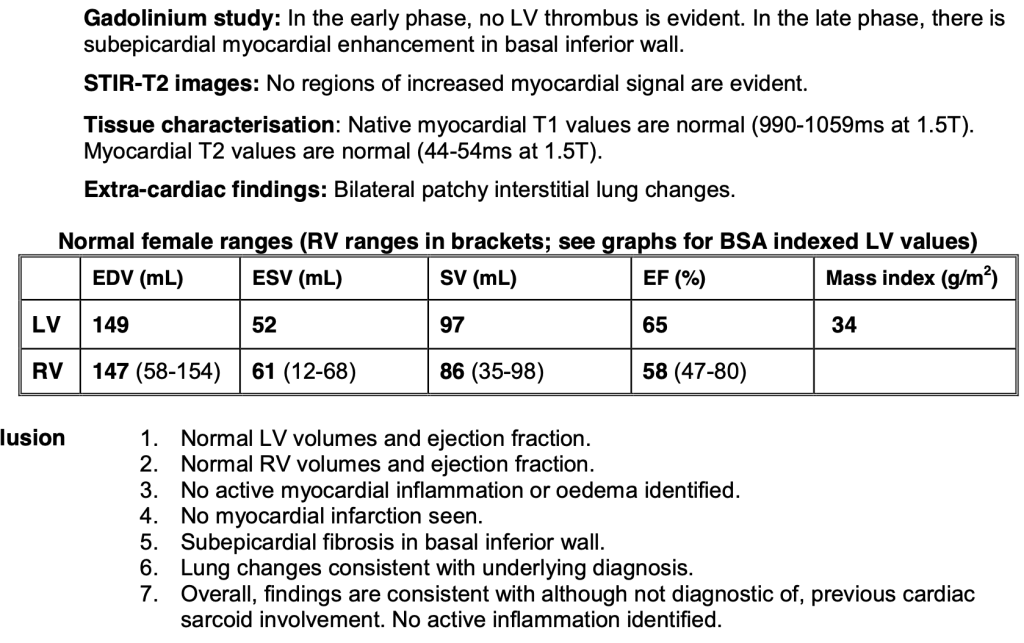
    I’m a 46-year-old British woman living with Pulmonary and Cardiac Sarcoidosis, diagnosed in 2021. I work full-time, I’m married, and I’m the proud mum of a twenty-something daughter who said to me back in January, ‘what you don’t change you choose!’ (thanks, I needed that).

    I’m currently on Methotrexate and Hydroxychloroquine — a combo that sounds like a potion from a wizard’s cabinet, I’ll go into detail about meds, side effects, and all that fun stuff in another post, but just know: I’ve been through it. And I’m still here, In fact as I type this I am better than I have been in 3 years.

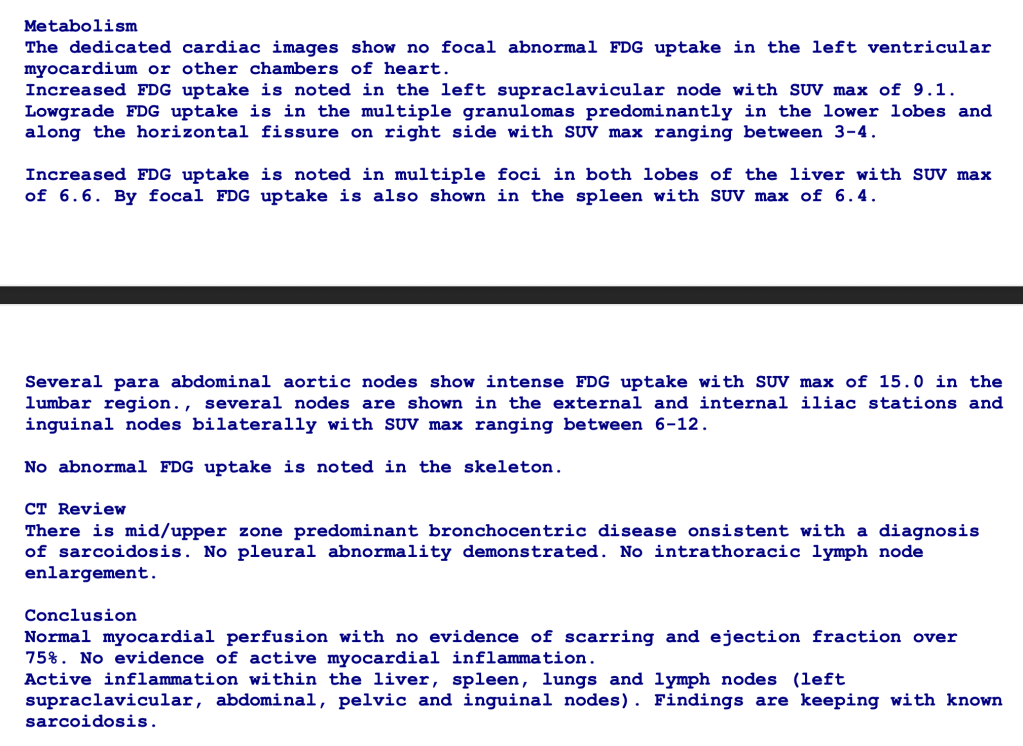
    My past test results? Coming soon. Spoiler alert: they’re confusing. Because of course they are. This is Sarcoidosis we’re talking about — it never does anything by the book.

    Why I’m Doing This

    When I was first diagnosed, I did what many of us do. I turned to the internet. I hoped to find someone — anyone — with a story like mine. I didn’t need miracles. I just wanted real. Real people. Real experiences. Real talk.

    Instead, I found a lot of medical jargon and nothing which shared how this thing might evolve. So, I decided to write the blog I wish I’d found back then.

    Since my diagnosis, I’ve asked a lot of questions (some of them annoying, I’m sure), navigated both the NHS and Bupa, and learned more about my body and mind than I ever planned to. There have been dark moments — fear, frustration, and that gnawing question of, Is this my life now? But there have also been breakthroughs, good days, small victories and epiphanies which are all part of the roller coaster of life.

    Where I Am Now

    Right now, I’m doing better than I have in years. Whilst much of what you read on Sarcoidosis would have you believe one day spontaneous remission makes it all go away, I haven’t experienced that. There have been times that I’ve had to really push to get the care I needed. I did my own research. I asked questions. I chased up appointments. Sometimes, I flat-out insisted there was more need for investigation. There’s been times when, if I hadn’t been persistent or paid for extra opinions, things could’ve got a lot worse. Heck I have even had to question medications being prescribed together after some unsavory symptoms!

    I’ve had to come to terms with using medications I never wanted to be on, and there’s definitely been some trial and error along the way. But through it all, I’ve been stubborn about one thing—I’m not giving up. My overwhelming advice is to always check things yourself, don’t rely on the system alone. This disease often requires a multidisciplinary medical team. Sometimes, things blur between departments. Don’t get me wrong; my Sarcoidosis doctors have been great however, the complex nature of things requires individual involvement. I hope my blog will help you navigate this.

    And somewhere in the middle of all this, I’ve realised that healing isn’t just about the physical stuff. It’s about mindset, grit, and finding a way to live with all the unknowns. It’s not just physical—it’s an emotional, mental, and even spiritual journey.

    Taking back control
    — in small, consistent ways — has been a turning point. And the biggest game-changer! Understanding that the mind plays a huge part in how we feel and what we’re capable of.

    What You’ll Find Here

    This blog isn’t just a medical diary (though yes, I will share my actual test results , medication stories, and the procedures I’ve been through). It’s also a place to find:

    • Books that made me think, laugh, or cry (sometimes all at once)
    • Quotes that have inspired me will be peppered throughout my blogs
    • Places that lifted my mood or offered peace
    • Wellness ideas that actually feel doable — no kale smoothies required
    • Products that bring me joy
    • Moments of honesty about when I’ve struggled, and what’s helped
    • Resources and reflections for navigating life with chronic illness

    Basically, it’s a bit of everything — with heart, humour, and zero fluff.

    The Quote That Keeps Me Going

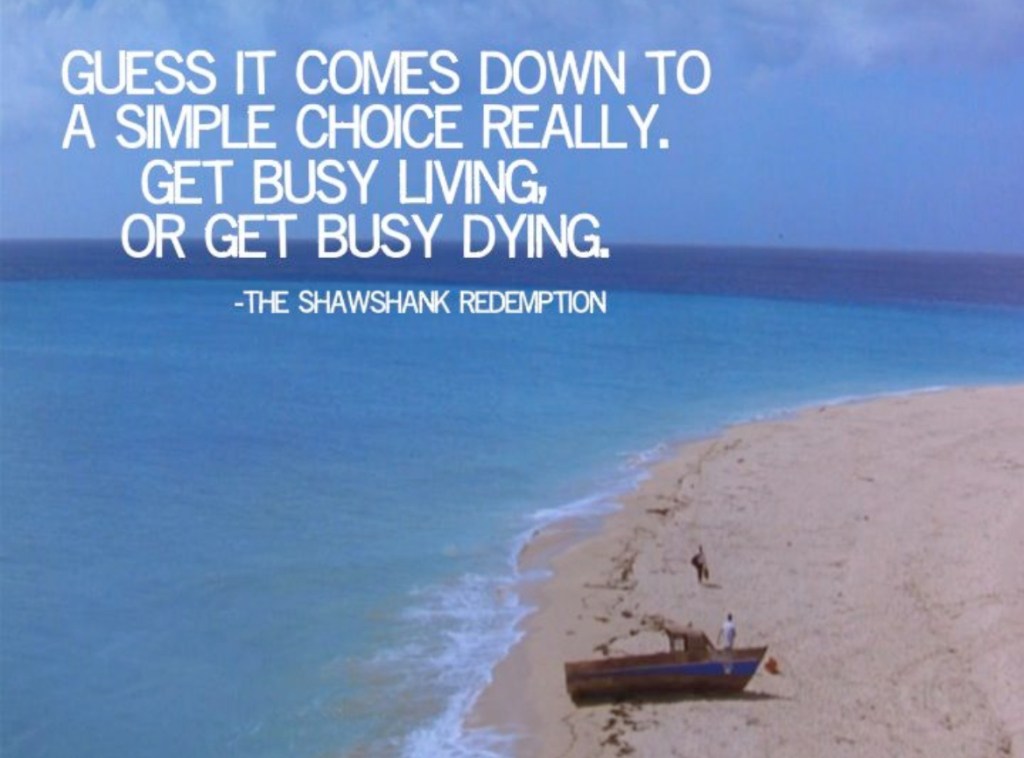
    There’s one line that’s stuck with me through all the ups and downs. You might recognise it from The Shawshank Redemption:

    “Get busy living, or get busy dying.”

    That’s the choice, isn’t it? Even when the odds feel stacked. Even when your energy’s low. Even when your medical chart reads like a Netflix drama. Every day, we get to choose. And I’m choosing to get busy living.

    Final Thoughts (For Now)

    I hope what I share here brings you something useful — whether it’s a laugh, a little clarity, or just the feeling that you’re not alone. I’m not a medical professional, so everything here comes from personal experience and personal research. But it’s real. And it’s honest.

    So grab that cuppa (or that glass of wine — no judgment here), and settle in. We’ve got a lot to talk about.

  • The one with the diagnosis…

    The one with the diagnosis…

    May to June 2021

    The day I finally had a name for it!

    Off to my appointment I went. The doctor’s surgery is only a ten-minute walk from my house, and I decided to walk there deliberately, wanting them to see exactly what my breathing was like after even a slow stroll.

    The GP was thorough — really thorough. She worked through a long list of checks and questions, then sent me straight through to the nurse for blood tests. Almost immediately, she picked up the phone to the local hospital and booked me in for a chest X-ray. She explained that she wasn’t happy with my breathing and that it needed investigating.

    I can’t really put into words how that moment felt. I cried. I was scared. I knew it was serious — and so did she. There was fear, of course, but alongside it was something else entirely: relief. Elation, even. For the first time, it was being taken seriously.

    I headed straight to the hospital, calling work to let them know I wouldn’t be contactable for a while. After the X-ray, I was sent to urgent care for more blood tests. I’d been there for about two hours when I was finally called in to see a doctor.

    He explained that there were markings on my lungs, but that he wasn’t sure what they were. He told me it didn’t look like cancer, and that there were several other possibilities. He suggested a CT scan, which he could arrange for the following day.

    The whole experience was strangely terrifying and deeply satisfying all at once. Terrifying because something was clearly wrong. Satisfying because I knew — finally — I was going to get answers.

    I went home gripped by anxiety, desperately wishing it was already tomorrow. I needed that CT scan. Even though the doctor had said he didn’t think it was cancer, I couldn’t get the big C out of my head.

    My husband was incredible. I lay in his lap and sobbed. I told him I was scared this was it — that it was terminal. I asked what we should do, whether we should tell our daughter, how we would even begin to talk about something like this. I was scared of dying. The thought wouldn’t leave me.

    What’s strange is that I didn’t think about cancer treatment or the long, exhausting journey people go through. My mind went straight to the end — the part where it’s over. I think that’s because my only real frame of reference was my nan, who died of lung cancer. That was the image my brain kept returning to.

    At the same time, none of it quite made sense. If this was cancer, then how did it explain everything else that had been happening to me? My inner voice kept arguing with itself: It can’t be cancer — it must be connected to all the other symptoms. So if it’s not cancer… what on earth is it?

    There wasn’t much sleep that night. I felt an odd sense of anticipation — almost excitement — at the thought of the unknown finally ending. And yet, I was terrified.

    The next day, I drove back to the hospital. As I made my way through the corridors towards the CT department, it suddenly dawned on me that I was walking through oncology. That realisation alone was enough to make my stomach drop.

    I had no idea I’d be having a cannula fitted — a small tube inserted into a vein to deliver fluid. The fluid, I was told, was contrast dye, used to highlight things on the scan. I was also warned that when the contrast was injected, I would feel like I was wetting myself… but that I absolutely wouldn’t be. As strange as that sounds, it’s exactly how it feels. At that point, you just have to trust the process.

    Thankfully, the scanner itself turned out to be more like a large doughnut rather than a tunnel — a huge relief, as I’m claustrophobic and had been terrified it would be the latter. Just for context, I’ve now done many MRIs since then, and only very recently managed one without tears thanks to a new strategy. But that’s a story for another time.

    The scan itself was quick enough. I was told the results would take time and that they’d be sent to my GP. The problem was, I absolutely could not wait.

    I know I’m very fortunate, and that not everyone has access to private healthcare, but I had BUPA through work. I contacted them immediately, found a lung specialist, and booked an appointment for three days later.

    This part feels important to share as advice: if you’ve had scans done on the NHS and you’re seeing a private consultant, you must get those scans emailed to you. The systems don’t always talk to each other. The secretary for the BUPA consultant told me I’d need to obtain them myself — and let me tell you, it wasn’t easy.

    But this was the first time I became truly persistent. I called. I emailed. I called again. I chased and chased until it was done. Eventually, I sent the scans to the secretary and waited — with absolute dread.

    I couldn’t sleep. I couldn’t think. Or rather, I couldn’t think about anything except what might be wrong with me.

    Finally, the day of the appointment arrived. It was online — we were still very much in COVID times, remember those? As soon as the consultant appeared on the screen, I felt a flicker of relief. He was here. He was going to tell me.

    He asked lots of questions, then pulled up my scans. He explained that his specialty was infectious lung disease, and that I would ultimately need to see someone else — but that he was very confident about what he was seeing on both the CT scan and the X-rays.

    Sarcoidosis.

    “What on earth is that?” I remember saying.

    He explained that the scan showed granulomas, and that Sarcoidosis was an inflammatory disease. My breathlessness was all a part of this. He told me he knew exactly the right person for me to see — a sarcoidosis pulmonary specialist at the Royal Brompton Hospital.

    I cried. I honestly couldn’t believe it. After everything, I was finally getting an answer.

    Interestingly, I would meet this doctor again later on — after I had a high aspergillus (fungal) test result. That led to more tests, which I’ll explain in another post.

    This was when I met Professor Peter George — a consultant respiratory physician, clinical lead at the Royal Brompton, and a specialist in sarcoidosis. He is part of the multidisciplinary team there, and although he probably has no idea the impact he’s had on my life, he truly has been exceptional.

    He is factual, calm, and deeply reassuring. I trusted him at every step, even when he said I should go on the dreaded prednisone. I spent two years under his direct care and am now back under the NHS, still within his team at the Royal Brompton.

    And I’ll say this plainly: if you think you have sarcoidosis or if you have it, you need to be under that team. Period.

    Next stop – test results and understanding the diagnosis.