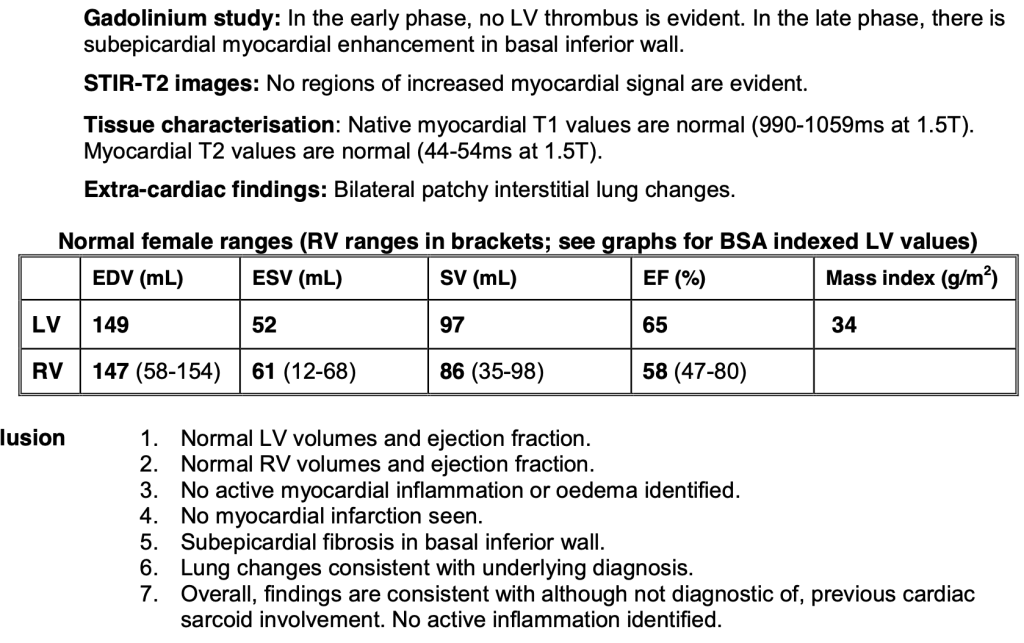
My heart looked strong and unaffected. However, the MRI didn’t 100% agree.
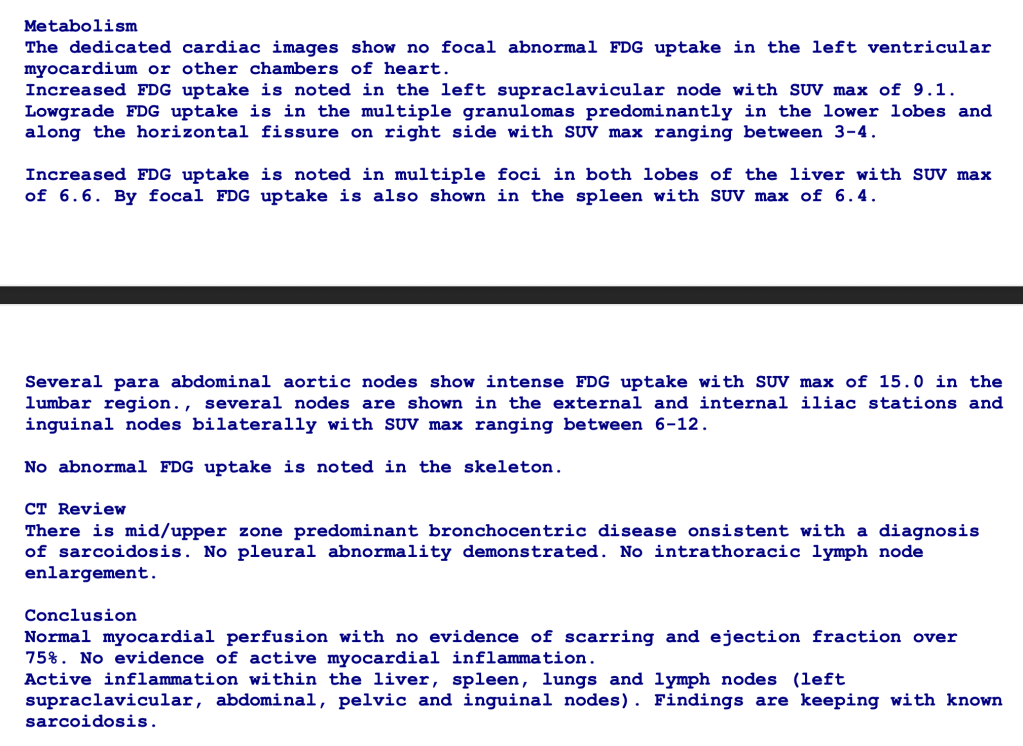
Sarcoidosis is active elsewhere (lungs, lymph nodes, liver, spleen)
The doctors reassured me that activity in the liver and spleen, while it sounded scary, is usually not something to panic over. These organs rarely develop serious issues, though it can happen in some cases. So for most people, it’s not nearly as concerning as problems in other organs.
The real focus, as I understood it, was on my lungs and heart—trying to prevent fibrosis from developing in the future. Spoiler alert: that plan didn’t entirely go as hoped.
Findings are consistent with sarcoidosis, not cancer.
The PET Scan helps to shine a light on all inflammation in the body.
SUV Max is basically the measure of how active something is on the PET Scan, the higher the uptake the higher the inflammation in this case.
Now for the MRI
When the dust finally settled and all the results were pulled together, the picture became clearer. There was no active inflammation in my heart — a sentence I didn’t realise I’d been holding my breath for. There was, however, a small area of fibrosis in the heart wall. The doctor explained that this was likely scarring from a previous cardiac episode, not something currently active. Taken as a whole, the diagnosis landed as pulmonary sarcoidosis, with limited cardiac involvement. So what next? how can I prevent scaring and how can I reduce the inflammation?
What I’m sharing here — the screenshots, the numbers, the clinical bits that normally live quietly in hospital portals — is really about context. It’s about showing you where I started, so you can understand the road between then and now. Because progress, especially with chronic illness, rarely looks like a straight line.
Somewhere along the way, fibrosis decided to make a subtle guest appearance. A small amount showed up in my lung, and yes, there’s some in my heart too. My 2025 scans showed low inflammation, and that’s a win I’m holding onto tightly. Next MRI and Scan May 20206.
I’m focused on doing the things within my control. I’m exercising. I’m eating well. I’m actively choosing positivity — not the toxic, glittery kind, but the stubborn, keep-going-even-when-it’s-hard kind.
And don’t get me wrong… it is hard. This journey is very much up and down. Two weeks ago I got the flu, and the last fortnight has been rough. Trying to get back into work and exercise has felt like starting from scratch — the kind where you finish a gentle workout and feel like you’ve been hit by a London double-decker bus.
The honest truth? I prioritise exercise over other things. If I have to choose between a social plan and moving my body, I’ll usually pick exercise — even knowing I’ll be exhausted afterwards. Not because I’m disciplined or virtuous, but because I’ve learned the hard way what happens when I don’t. I need to stay strong. Physically, yes — but mentally too.
After my initial diagnosis, and the prednisone saga I’ll talk about later, I was unbelievably weak and in so much pain I genuinely felt about 90 years old. Everything hurt. Everything was hard. And that version of me is never far from my memory. I looked in the mirror and I didn’t see me any more. Now I am holding onto me, the me I expect to see in the mirror.
Today, I am not feeling great but “this to shall pass”
One last suggestion, try and get copies of your test results, sign up to your hospital portal if you can, if not ask for them. You need to be your biggest advocate, you need to do your own research. There have been times where if I hadn’t things could have been worse.
You’ve landed in the right place. You’re not alone. Maybe you’ve just been diagnosed. Perhaps you live with someone who has it or your late-night Googling might have taken a sharp left turn into “rare diseases you didn’t ask for.”
This blog is for you — the curious, the confused, the newly diagnosed, or the long-time warrior just trying to make sense of it all.
What Even Is Sarcoidosis?
Sarcoidosis is often called a snowflake disease. It isn’t because it’s cute and sparkly (although, let’s be honest, some of us do have a glow about us). It is called that because no two cases are exactly alike. It’s rare, confusing, and frankly, a bit of a diva. One minute it’s hanging out in your lungs, the next moment, it’s partying on your joints like it’s 1999. Charming.
And while it’s absolutely not a joke, sometimes the only way to get through this mystery of a disease is to laugh. So yes, you’ll find real talk here. But you’ll also find humour. There is a bit of friendly sarcasm. You’ll read honest reflections on what it’s like to live with something that even some doctors have to Google.
So here is my definition of Sarcoidosis. Sarcoidosis is a condition where the immune system goes a little haywire. It starts forming tiny clumps of cells called granulomas in different parts of the body. These clumps can show up in one or more organs. If too many build up, they can start messing with how those organs work. Over time, if the inflammation doesn’t get under control, it can cause permanent scaring otherwise known as fibrosis. This disease hits the lungs most often (about 90% of the time), but it can affect pretty much any organ including the skin. Even though research is improving, it’s still tricky to diagnose, hard to treat, and there’s no cure yet.
Sarcoidosis doesn’t act the same for everyone. Some people go into remission and never have another issue. Others might go into remission and then deal with flare-ups down the line. For some it doesn’t always roar, instead simmering away like an ember just waiting.It’s a mixed bag.
I’ve found the uncertainty of what might happen next to be the worst part. One minute I feel okay, and the next I get slammed with fatigue like I’ve been hit by a bus. It’s so frustrating, especially when I’ve got plans or things I want to do. Not knowing how I’m going to feel from day to day really gets to me.
I also hate being unwell for work or showing any weakness. I try to keep up. If I’ve had a big week or I’ve been traveling with work, I end up completely exhausted. But from the outside, no one can tell. I’ve got makeup on, I look fine so people assume I am fine, why wouldn’t they? So I feel like a bit of a fraud, I worry about being judged, weak or worse people not believing I am unwell so I don’t say anything. I’ve lost count of how many times I’ve just carried on regardless, struggling in silence.
Who Am I?
I’m a 46-year-old British woman living with Pulmonary and Cardiac Sarcoidosis, diagnosed in 2021. I work full-time, I’m married, and I’m the proud mum of a twenty-something daughter who said to me back in January, ‘what you don’t change you choose!’ (thanks, I needed that).
I’m currently on Methotrexate and Hydroxychloroquine — a combo that sounds like a potion from a wizard’s cabinet, I’ll go into detail about meds, side effects, and all that fun stuff in another post, but just know: I’ve been through it. And I’m still here, In fact as I type this I am better than I have been in 3 years.
My past test results? Coming soon. Spoiler alert: they’re confusing. Because of course they are. This is Sarcoidosis we’re talking about — it never does anything by the book.
Why I’m Doing This
When I was first diagnosed, I did what many of us do. I turned to the internet. I hoped to find someone — anyone — with a story like mine. I didn’t need miracles. I just wanted real. Real people. Real experiences. Real talk.
Instead, I found a lot of medical jargon and nothing which shared how this thing might evolve. So, I decided to write the blog I wish I’d found back then.
Since my diagnosis, I’ve asked a lot of questions (some of them annoying, I’m sure), navigated both the NHS and Bupa, and learned more about my body and mind than I ever planned to. There have been dark moments — fear, frustration, and that gnawing question of, Is this my life now? But there have also been breakthroughs, good days, small victories and epiphanies which are all part of the roller coaster of life.
Where I Am Now
Right now, I’m doing better than I have in years. Whilst much of what you read on Sarcoidosis would have you believe one day spontaneous remission makes it all go away, I haven’t experienced that. There have been times that I’ve had to really push to get the care I needed. I did my own research. I asked questions. I chased up appointments. Sometimes, I flat-out insisted there was more need for investigation. There’s been times when, if I hadn’t been persistent or paid for extra opinions, things could’ve got a lot worse. Heck I have even had to question medications being prescribed together after some unsavory symptoms!
I’ve had to come to terms with using medications I never wanted to be on, and there’s definitely been some trial and error along the way. But through it all, I’ve been stubborn about one thing—I’m not giving up. My overwhelming advice is to always check things yourself, don’t rely on the system alone. This disease often requires a multidisciplinary medical team. Sometimes, things blur between departments. Don’t get me wrong; my Sarcoidosis doctors have been great however, the complex nature of things requires individual involvement. I hope my blog will help you navigate this.
And somewhere in the middle of all this, I’ve realised that healing isn’t just about the physical stuff. It’s about mindset, grit, and finding a way to live with all the unknowns. It’s not just physical—it’s an emotional, mental, and even spiritual journey. Taking back control — in small, consistent ways — has been a turning point. And the biggest game-changer! Understanding that the mind plays a huge part in how we feel and what we’re capable of.
What You’ll Find Here
This blog isn’t just a medical diary (though yes, I will share my actual test results , medication stories, and the procedures I’ve been through). It’s also a place to find:
Books that made me think, laugh, or cry (sometimes all at once)
Quotes that have inspired me will be peppered throughout my blogs
Places that lifted my mood or offered peace
Wellness ideas that actually feel doable — no kale smoothies required
Products that bring me joy
Moments of honesty about when I’ve struggled, and what’s helped
Resources and reflections for navigating life with chronic illness
Basically, it’s a bit of everything — with heart, humour, and zero fluff.
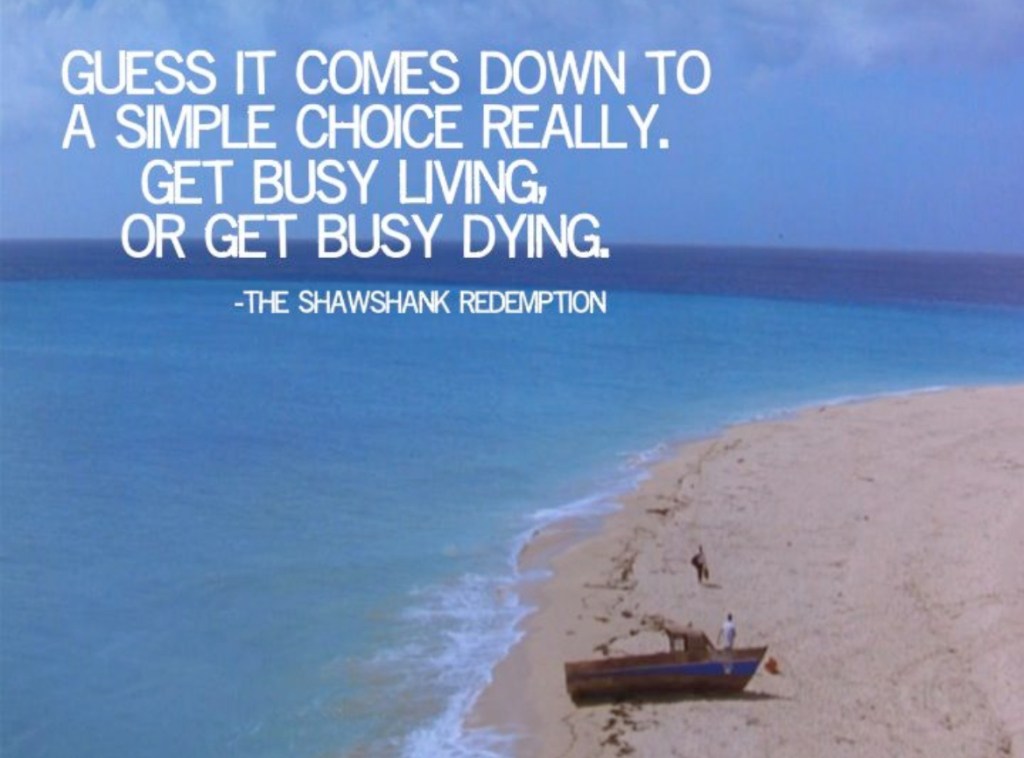
The Quote That Keeps Me Going
There’s one line that’s stuck with me through all the ups and downs. You might recognise it from The Shawshank Redemption:
“Get busy living, or get busy dying.”
That’s the choice, isn’t it? Even when the odds feel stacked. Even when your energy’s low. Even when your medical chart reads like a Netflix drama. Every day, we get to choose. And I’m choosing to get busy living.
Final Thoughts (For Now)
I hope what I share here brings you something useful — whether it’s a laugh, a little clarity, or just the feeling that you’re not alone. I’m not a medical professional, so everything here comes from personal experience and personal research. But it’s real. And it’s honest.
So grab that cuppa (or that glass of wine — no judgment here), and settle in. We’ve got a lot to talk about.

 CuriousBethLivingLife